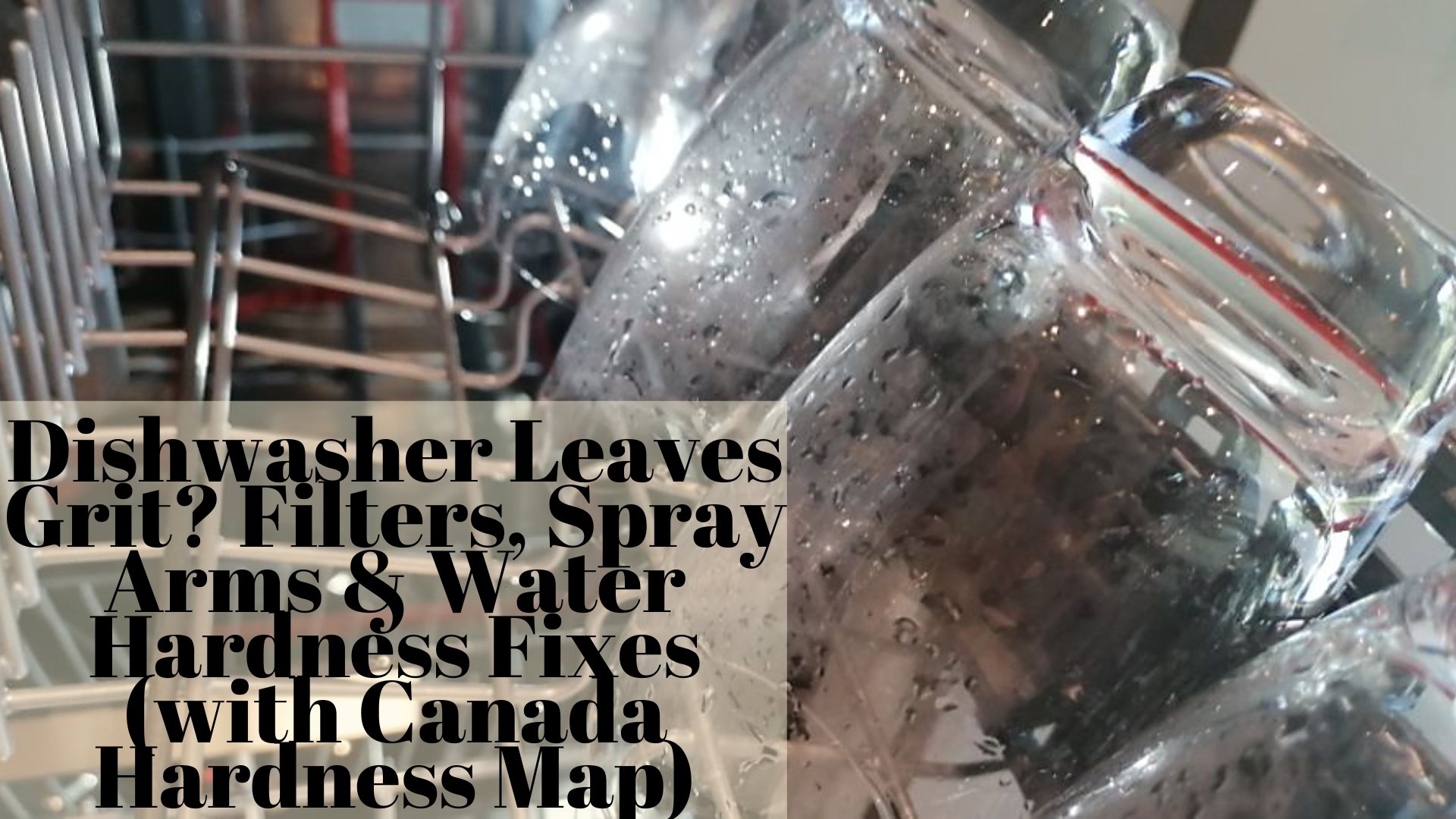

Why Your Dishwasher Leaves Grit—and How to Fix It (Filters, Spray Arms, Hard Water)
Gritty glasses and sandy plates aren’t just annoying—they’re a sign your dishwasher self-cleaning ecosystem is out of balance. The good news: most causes are simple and DIY-friendly. This guide walks you through filter and spray-arm cleaning, detergent and rinse-aid tuning, and the role water hardness plays (including a Canada-specific hardness map). We’ll also flag when a part may be failing and what to try next.
Quick note: Appliance Rescue does not offer repair services. The site provides Expert Guides, Appliance Tips, and Troubleshooting Advice to help you solve problems yourself. Have a question? Contact us.
Why do dishes come out gritty
- Clogged filter — Food soils collect faster if you run many quick cycles or skip pre-rinse on heavy soils. A jammed filter recirculates debris.
- Plugged spray-arm nozzles — Seeds, pasta bits, and hard-water scale block the tiny jets, reducing pressure and spray pattern.
- Low water temperature or pressure — Grease doesn’t break down, and granules don’t flush away.
- Detergent/rinse-aid mismatch — Too little detergent (or no rinse aid) in harder water means soils redeposit. Too much detergent can leave undissolved residue that looks like grit.
- Hard water — Minerals make wash water “sticky,” so particles cling to surfaces and jets scale up.
- Loading or cycle choice — Nesting bowls or an overstuffed lower rack blocks the spray, trapping debris.
10-minute diagnosis checklist
- Run the hot water tap at your sink for 30–60 seconds; start the dishwasher so it fills with already-hot water.
- Open mid-cycle (carefully) 5–10 minutes in: water should be very hot and steamy. If it’s lukewarm, increase the water-heater setting to ~49–54 °C (120–130 °F) and enable “Sani/Boost” or “Hi-Temp Wash.”
- Check the detergent pod cup after the first pre-wash: if a pod remains intact, select a cycle with a longer main wash or switch to powder/gel and dose appropriately.
- Listen for strong spray action. A weak whoosh suggests clogged arms or low incoming pressure.
Deep clean: filter and sump (the #1 fix)

Tools: soft brush, old toothbrush, sink sprayer, dish soap, towel.
- Remove the lower rack and lift out the filter screen(s). Most twist counterclockwise; some have a tab.
- Rinse under warm water. Use the toothbrush to dislodge pulp, eggshell flecks, and coffee grounds.
- Inspect the fine mesh against light. Any “dark clouds” are packed debris—keep brushing from both sides until light passes evenly.
- Check the sump inlet (the opening below the filter) for glass chips, fruit stickers, and olive pits. Tweeze out any obstructions.
- Reassemble firmly—an unseated filter lets debris bypass and recirculate.
Tip: If you routinely see grit, clean the filter monthly; weekly for heavy users or if you love quick cycles.
Unclog and descale the spray arms

Tools: wooden toothpicks, paper clip, white vinegar.
- Pop off the lower (and, if removable, upper) spray arm.
- Hold under a light and probe each nozzle with a toothpick/clip to clear food plugs.
- Back-flush: run warm water through the center hub until the flow from all jets is even.
- For mineral crust, soak in warm vinegar (20–30 min), then rinse.
- Reinstall and confirm the arm spins freely with a gentle flick.
Detergent, rinse aid, and cycle tuning
- Match dose to hardness.
- Soft water (0–60 ppm / 0–3.5 gpg): use less detergent; too much can haze and leave “gritty” crystals.
- Moderate (60–120 ppm / 3.5–7 gpg): standard pod or 2–3 tsp powder.
- Hard (120–180 ppm / 7–10.5 gpg) & Very hard (>180 ppm / >10.5 gpg): consider a premium detergent, add rinse aid, and select a longer/hotter cycle.
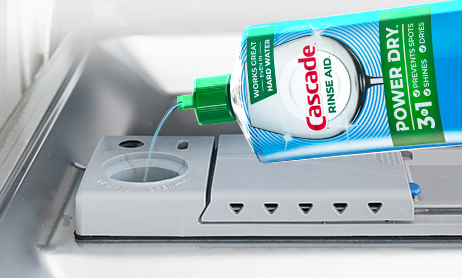
- Rinse aid: set to 2–3 of 5 to improve sheeting and particle flush-off.
- Heat & dry options: enable Hi-Temp and Extended Dry; higher temps reduce sticky residues.
- Use the right cycle: “Auto/Normal” is fine for daily loads; choose Heavy for greasy pans or gritty plates.
How water hardness drives grit

Hard water carries calcium and magnesium. In the wash, minerals bind detergent and raise surface tension, so soils don’t lift well and micro-particles don’t rinse away. Scale also narrows spray-arm orifices, cutting pressure. If you’re fighting grainy residue and your filter and arms are clean, hardness is your likely culprit.
Quick ways to check hardness at home
- Strip test (aquarium aisle or hardware store): dip and compare colour; gives ppm/gpg range.
- Municipal report: search your city name + “water hardness” for the latest value.
- Indicators: chalky white film on kettle elements or faucets suggests hard water.
Canada water hardness map (quick reference)

Water sources vary by city and even by neighbourhood; consider this a practical guide, not an absolute. Always adjust based on your own test results.
- Very soft to soft (0–60 ppm):
- BC Coast (e.g., Vancouver, Victoria) – mostly surface reservoirs; typically soft.
- Quebec (many surface-water systems, incl. Montréal) – often soft to moderately soft.
- Northern territories (surface-fed communities) – commonly soft, but variable.
- Moderately hard (60–120 ppm):
- Atlantic Canada (NS/NB/PEI coastal systems) – mixed but often in the moderate band.
- Southern Manitoba & parts of Ontario (surface-water blends) – ranges into moderate.
- Hard to very hard (120–300+ ppm):
- Prairie provinces (Alberta, Saskatchewan, parts of Manitoba) – cities like Calgary, Regina, Saskatoon often report hard/very hard levels.
- Southern Ontario corridor (Kitchener-Waterloo, Guelph, London, Cambridge, many well-water communities) – frequently hard due to groundwater sources.
- Rural well-water across Canada – commonly hard to very hard.
Province-by-province snapshot (typical tendencies)
- BC: Soft on the coast; interior varies (some moderate/hard pockets).
- AB: Frequently hard to very hard (especially Calgary and many smaller centres).
- SK: Predominantly hard/very hard.
- MB: Winnipeg moderate; many other communities hard.
- ON: Mixed—Toronto area can be moderate; many groundwater-supplied cities are hard.
- QC: Often soft to moderately soft, depending on source.
- NB/NS/PEI/NL: Mixed; many systems moderate, some hard pockets and softer coastal/surface supplies.
- YT/NT/NU: Variable; many communities soft, but check local reports.
Action step: If your test reads ≥150 ppm (≈9 gpg), expect more scale and grit risk. Boost detergent slightly, use rinse aid, and consider softening options below.
Hard water fixes that actually work

- Detergent strategy
- Prefer powder or a high-performance pod in very hard water; powders let you fine-tune the dose.
- Start with 1 tbsp (≈15 mL) powder in very hard water; adjust by ½ tbsp until glasses rinse clean.
- Rinse aid
- Keep reservoir topped up; set 3–4 (of 5) in very hard water to improve sheeting and particle carry-off.
- Descale routine
- Monthly: run a hot empty cycle with a dishwasher cleaner or 2 cups of white vinegar in a bowl on the top rack (no dishes). This dissolves scale in pumps, channels, and jets.
- In-line softening
- If your home lacks a whole-house softener, consider:
- Under-sink cartridge feeding the dishwasher (phosphate-free scale control).
- Portable dishwasher salt systems (for models that accept salt) or additive products that bind minerals in the wash.
- If your home lacks a whole-house softener, consider:
- Whole-home softener
- Most reliable for very hard regions; protects appliances and plumbing, and often pays back via lower detergent use.
Loading and maintenance habits that reduce grit

- Face the soil toward the spray, avoid nesting, and keep a gap between plates.
- Top rack for glasses; avoid blocking the tablet dispenser with tall items.
- Scrape (don’t pre-rinse) heavy solids to protect the filter without sacrificing the detergent’s ability to work on.
- Clean the filter monthly, arms quarterly (monthly if you see scale).
- Check the inlet screen (where the water hose attaches) yearly; a partially blocked screen reduces pressure.
When it’s not user-serviceable
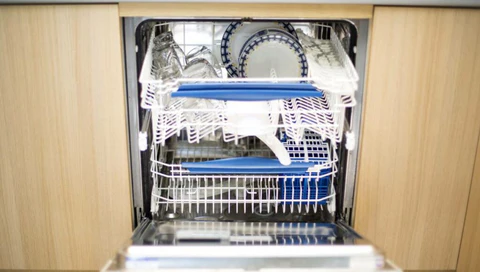
If you still see grit after all of the above, you may have:
- A weak circulation pump (impeller damage, worn seals).
- A sticking diverter valve (poor upper-rack wash).
- Heating element failure (low wash temperatures).
- Broken check valve (backflow of debris).
These issues usually present with additional clues: unusual noises, standing water, or error codes. Consult your user manual’s diagnostics. While Appliance Rescue doesn’t provide repairs, the site’s guides can help you identify symptoms and next steps. If you have a question about the process or need clarification, Contact us.
Your action plan (5 steps)

- Clean the filter and sump thoroughly.
- Unclog and descale the spray arms.
- Raise wash temperature (water heater to ~49–54 °C; enable Hi-Temp).
- Match detergent & rinse aid to hardness; consider powder in very hard water.
- Adopt a monthly descaling routine; evaluate in-line or whole-home softening if ≥150 ppm.
If you want a second pair of eyes or a sanity check on your hardness reading and detergent dose, the guides and tips at Appliance Rescue are a good next stop—or simply Contact us and share your setup.