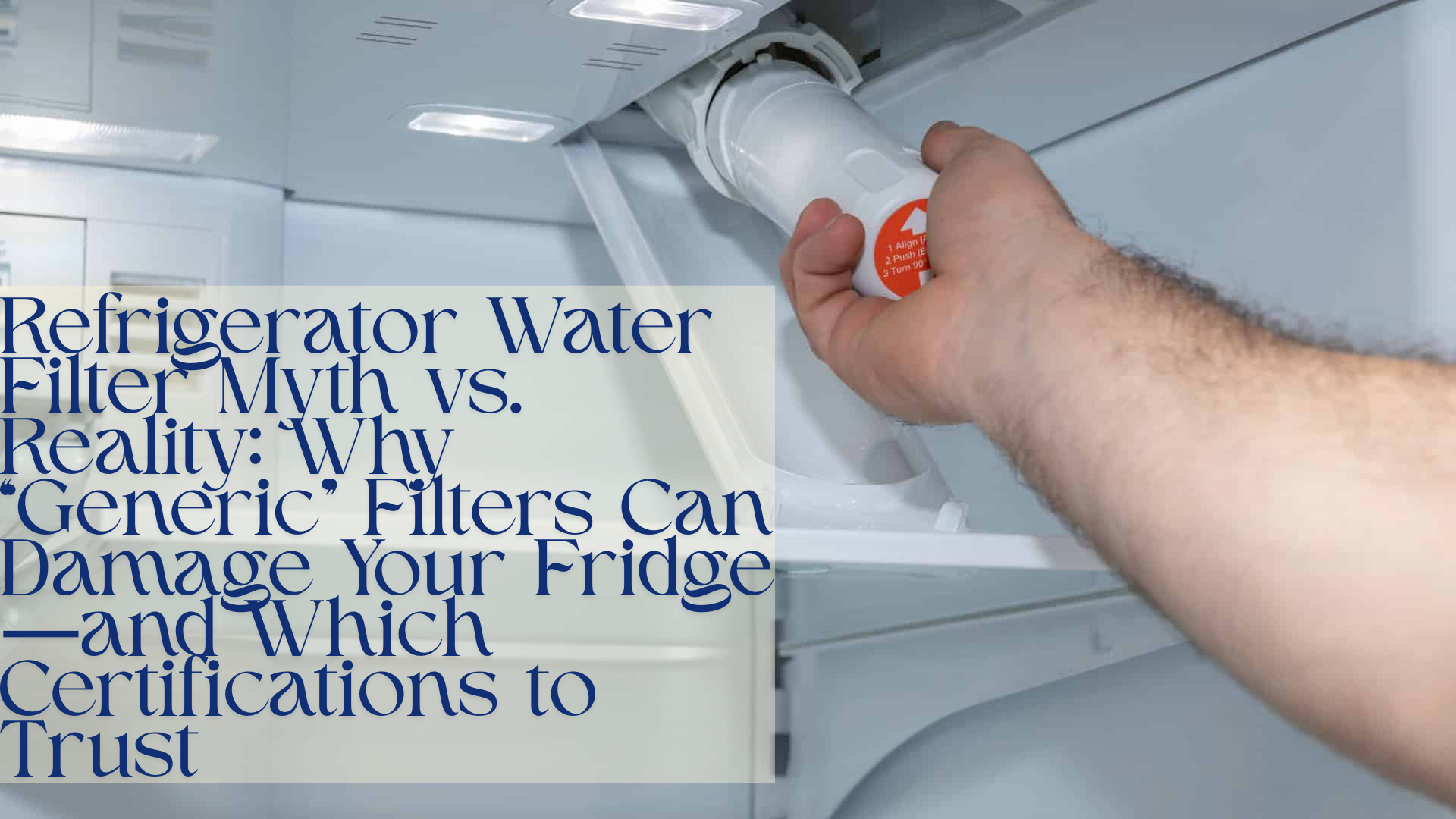

Why Generics Can Damage Your Fridge—and What to Trust
Refrigerator water dispensers make life easy—until the time comes to replace the filter. A quick search turns up a flood of “compatible” or “universal” cartridges that cost a fraction of the original parts. The marketing is persuasive: same performance, lower price. But the truth is more complicated. In this guide, we separate myth from reality, explain how the wrong filter can harm your fridge (and your ice maker), and show you the certifications that actually matter so you can buy with confidence.
Note: Appliance Rescue doesn’t sell parts or offer repair services. We provide Expert Guides, Appliance Tips, and Troubleshooting Advice to help you make informed decisions. Explore more at Appliance Rescue or reach out via Contact us.
The quick takeaway (for the busy reader)
- Generic ≠ certified. Some generics are fully certified; many are not. Packaging often uses “tested to” language that is not the same as accredited certification.
- Fit is not a minor detail. A slightly off-spec O-ring or connector can cause slow leaks that damage cabinetry, flooring, and internal fridge components.
- Performance varies widely. Without third-party certification, claims about chlorine reduction, lead reduction, PFAS reduction, or flow rate are hard to verify.
- Look for specific labels: NSF/ANSI 42 (taste/odor/particulates), NSF/ANSI 53 (health contaminants like lead), NSF/ANSI 401 (emerging compounds), NSF/ANSI 372 (lead-free materials), and reputable programs like WQA Gold Seal.
Myth vs. Reality

Myth 1: “If it fits, it works.”
Reality: A filter does more than just “sit” in the housing. It must seal precisely to maintain correct pressure and flow. Slightly undersized or over-hard O-rings, out-of-tolerance bayonet lugs, or connectors with rough molding can:
- Allow bypass (unfiltered water sneaks around the media).
- Cause micro-leaks that appear as intermittent drips, puddles under crisper drawers, or swelling wood floors over time.
- Put strain on the bypass valve or head assembly, accelerating wear and causing persistent “check filter” errors.
Myth 2: “All filters remove lead, PFAS, and pharmaceuticals.”
Reality: Filters are engineered for specific contaminant classes. Many bargain cartridges only claim NSF/ANSI 42 (aesthetic chlorine, taste, odor, and particulate). That does not guarantee a reduction of lead, cysts, VOCs, or PFAS. If you need health-based reductions, look for NSF/ANSI 53 and/or NSF/ANSI 401, and verify that the exact contaminant is listed on the certification record.
Myth 3: “Generic filters save money without trade-offs.”
Reality: Upfront savings can evaporate if a faulty seal leads to:
- Hidden water damage (baseboards, subflooring, adjacent cabinetry).
- Clogged ice makers from carbon fines or resin beads shedding into the water line.
- Reduced flow that burns out small solenoids or makes dispensers unreliable.
Even a single service call or panel replacement can cost far more than a genuine, certified cartridge.
Myth 4: “The box says ‘tested to NSF’—so it’s certified.”
Reality: Phrases like “meets, tested to, conforms to, or compatible with NSF standards” are not the same as NSF/ANSI certification by an accredited body. Proper certification includes:
- A standard number (e.g., NSF/ANSI 53).
- The certifying body’s mark (e.g., NSF, WQA Gold Seal).
- A model number that matches the one printed on the cartridge and the public listing.
How non-certified filters can damage your refrigerator

- Head assembly wear: Repeated insertion of out-of-tolerance connectors deforms the filter head’s seals and spring-loaded mechanisms, causing persistent leaks even with a correct filter later on.
- Ice maker failures: Poor filtration can let fine carbon dust pass downstream. Those fines accumulate in the ice mold feed tube and valve screens, leading to small, frequent jams.
- Valve and pump strain: Incorrect media density or blocked channels raise backpressure. The dispenser slows, the inlet valve fights to maintain flow, and components age faster.
- Sensor confusion: Some fridges monitor flow or pressure drop as part of filter status. A generic cartridge with atypical resistance can trigger nuisance warnings—or mask a clog.
- Material incompatibility: Low-grade plastics and adhesives can become brittle in cold, high-humidity compartments, increasing crack and leak risk.
The certifications that matter (and what they actually mean)
When shopping, check the exact combination of these standards—each one addresses different concerns:
- NSF/ANSI 42 – Aesthetic Effects
Validates reduction of chlorine taste & odor and particulate Class I–III. Good baseline; not a health-effects standard. - NSF/ANSI 53 – Health Effects
Tests the reduction of contaminants that affect health, such as lead, cysts, mercury, certain VOCs, and others. Look for the specific contaminant in the listing—certification is claim-by-claim, not blanket approval. - NSF/ANSI 401 – Emerging Compounds/Incidental Contaminants
Covers newer contaminants (e.g., select pharmaceuticals, herbicides, flame retardants). Helpful if your water utility reports these. - NSF/ANSI 372 – Lead-Free Materials
Confirms the filter’s material composition meets lead-free requirements. This complements, but does not replace, NSF/ANSI 53 lead-reduction performance. - WQA Gold Seal or IAPMO Marks
Reputable certification programs verifying both performance and manufacturing consistency. As with NSF, always confirm the model in the public directory.
How to verify:
Search the certifier’s public listings for the brand + model number printed on the cartridge itself. Packaging claims are not enough. If the listing doesn’t show your exact model, treat performance claims with skepticism.
OEM vs. third-party: a practical way to decide
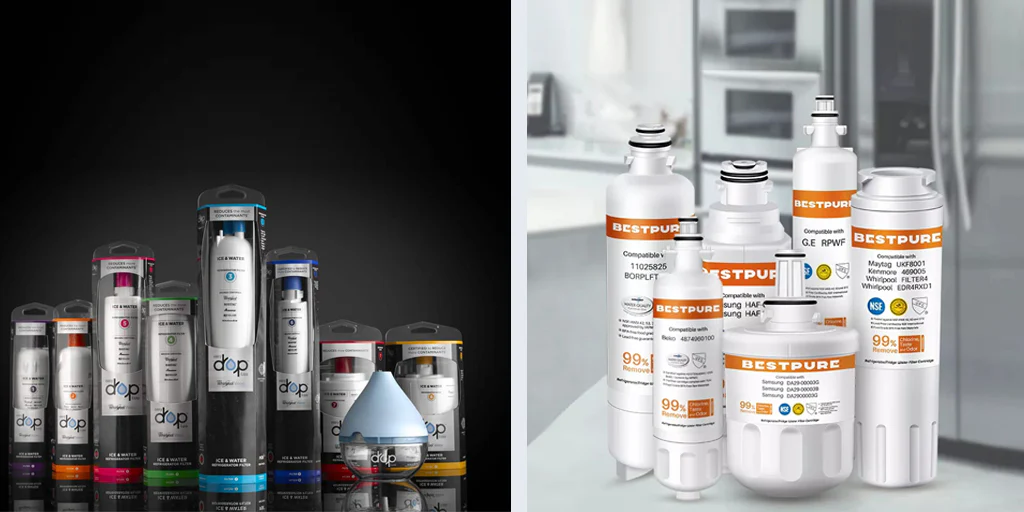
- Choose OEM when:
- Your fridge is under warranty and requires genuine parts.
- You’ve had leaks or filter-head replacements in the past.
- You need documented reduction of specific contaminants (lead, cysts, PFAS) and want the simplest verification path.
- Consider a certified third-party when:
- You can verify NSF/ANSI and/or WQA certification for the exact model.
- The manufacturer publishes pressure, flow (gpm), capacity (gallons or liters), and contaminant lists consistent with the certification directory.
- The cartridge has clear lot codes and a warranty that covers water damage (read the fine print).
Reading the fine print: the four clues of a trustworthy filter
- Clear standards and marks: The label shows NSF/ANSI numbers and a certifier logo, not just “meets” language.
- Model parity: The certification directory lists the same model number and the same claims as the packaging.
- Transparent specs: The data sheet includes flow rate, pressure range, temperature range, and capacity (e.g., “200 gallons or 6 months,” whichever comes first).
- Traceability: Lot/batch codes, manufacturing location, and customer support details are visible and scannable.
Installation and maintenance tips that prevent headaches

- Prime the cartridge: Run 2–4 liters (or the manufacturer’s stated amount) through the dispenser to flush carbon fines and air.
- Check for weeping: After installation, dry the filter area, then check again at 15 minutes and 24 hours. Look for cool, damp spots and listen for faint hissing.
- Replace on schedule: Typical capacity is 150–300 gallons (570–1,100 L) or 6 months. Heavy use, high sediment, or reduced flow may require earlier replacement.
- Use a saddle valve filter? If your home has a separate inline filter, change both on staggered schedules to avoid pressure spikes and flow anomalies.
- Keep records: Note install dates, brands, and any symptoms. Patterns (like recurring slow flow in month four) help diagnose issues.
Troubleshooting: symptoms indicate a filter is to blame
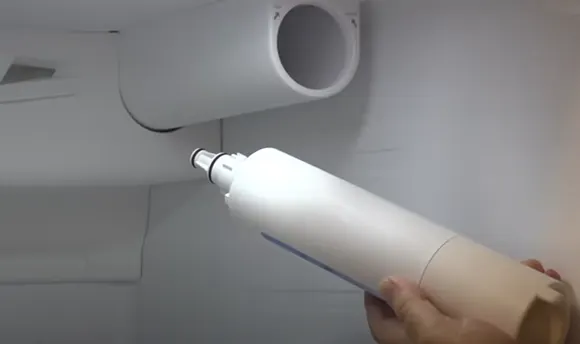
- Sudden drop in flow: Possible clog or collapsed media; replace the filter and purge air.
- Cloudy/white ice: Air entrainment from poor sealing or fines shedding; re-seat or replace the cartridge and flush longer.
- Random dripping into the fresh-food compartment: Check the filter head and O-ring seating; inspect for hairline cracks and replace if needed.
- Chattering or clicking on dispense: Often linked to abnormal backpressure; ensure you’re using a filter that meets the fridge’s flow spec.
Cost math: “cheap” can be expensive
A non-certified filter might save $20–$40 today. But a slow leak can warp hardwood or damage nearby cabinetry—often hundreds of dollars to fix—plus the cost of a replacement filter head or ice maker assembly. Certified filters, whether OEM or reputable third-party, mitigate that risk by controlling tolerances, media quality, and seal materials—and by proving contaminant reduction where it counts.
Buyer’s checklist (print this before you shop)

- The box shows NSF/ANSI standard numbers (42/53/401/372) and a certifier mark (NSF, WQA, IAPMO).
- The exact model number appears in the certifier’s public listing with the same claims.
- Specs include flow rate, pressure/temperature range, and capacity.
- The seller provides lot codes, warranty terms, and responsive support.
- After installation, you flush the line and re-check for leaks within 24 hours.
Final word
Generic refrigerator filters aren’t all bad, but many are built to a price, not a standard. The safest path is simple: verify certification, confirm fit, and monitor after installation. Do that, and you’ll protect both your water quality and your refrigerator.
Want more plain-English guides and DIY help? Browse Appliance Rescue for Expert Guides, Appliance Tips, and Troubleshooting Advice. Have a question or a sticky issue with filter fitment? Contact us and we’ll point you to the right resources.